
What if the next place your customer sees an ad isn’t a search result, but a conversation?
Imagine asking ChatGPT:
“I’m looking for a laptop for graphic design. I use Figma and Photoshop, travel often, and don’t want to spend more than $1,500. What should I look for?”
You haven’t searched for a specific product. You have described a need.
And that is what makes advertising inside ChatGPT so different.
OpenAI has introduced advertising into ChatGPT, creating a new environment where brands can reach people while they are researching, comparing options and making decisions. Ads appear separately from ChatGPT’s answers, and OpenAI says they do not influence the answers themselves.
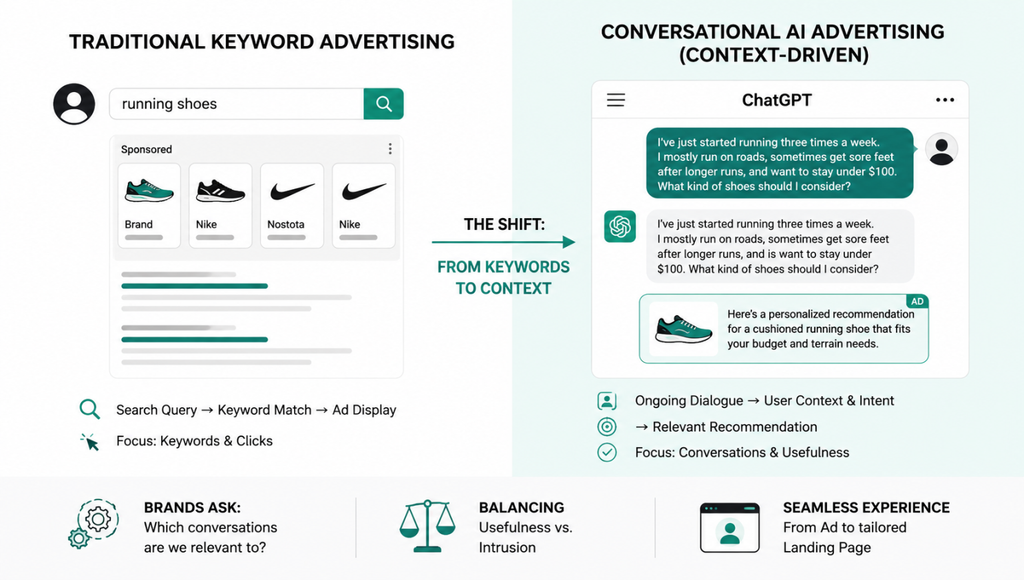
A visual comparison showing the shift from traditional, keyword-reliant search advertising to context-driven conversational placements.
The bigger story, however, isn’t simply that ChatGPT now has ads.
It is that advertising is moving from keywords towards conversations.
From Keywords to Context
Traditional search advertising often follows a familiar path:
Search → Keyword → Ad → Click
Conversational AI adds something search has historically had less of: context.
Take another example.
“I’ve just started running three times a week. I mostly run on roads, sometimes get sore feet after longer runs, and want to stay under $100. What kind of shoes should I consider?”
The user has revealed much more than a search query.
They have shared their activity, preferences, problems and budget.
The commercial intent is still there, but it is wrapped inside a conversation.
That creates a new question for marketers:
Instead of only asking which keywords to target, should brands start asking which conversations they could be relevant to?
This Is Already a Real Advertising Channel
ChatGPT Ads are no longer purely experimental.
OpenAI has expanded its advertising programme and introduced tools including CPC bidding, self-serve campaign management and conversion measurement.
Meanwhile, early industry tracking has identified hundreds of advertisers appearing across ChatGPT, spanning categories such as retail, software, travel and consumer products.
Consider a travel example.
Someone asks:
“I’m planning a four-day trip somewhere warm. I want good weather, but somewhere quieter and not too expensive.”
A travel brand appearing in that conversation is reaching the person while they are actively defining their trip.
That is fundamentally different from showing the same person a generic travel banner while they are reading an unrelated article.
The conversation creates the context for the ad.
Advertising Creative Need to Change
This shift could influence how brands communicate too.
A traditional message might be:
“Discover our complete range of business software.”
A contextual message could be:
“Managing orders, payments and inventory? See how our platform brings them together.”
The difference is not necessarily the product.
It is the situation.
As advertising becomes more contextual, brands need to think less about creating one message for an audience and more about the different situations in which their product becomes useful.
That also makes content more important.
If customers are using AI to research before buying, brands need information that helps them answer questions, compare options and understand solutions not just promotional copy.
The Experience Doesn’t Stop at the Ad
There is another important implication.
Imagine someone spends several messages explaining exactly what they need, sees a relevant advertisement and clicks through — only to land on a generic homepage with no obvious connection to their original need.
The ad understood the context.
The website didn’t.
That makes the landing page, UX and content part of the same experience.
A relevant ad can earn the click. A relevant digital experience has to earn the conversion.
For agencies and digital teams, this makes the connection between advertising, content and UX even more important.
But Relevance Has a Limit
Conversational advertising also raises an important question:
When does relevance become intrusion?
People use ChatGPT for product research, but also for writing, learning, planning and personal conversations.
Not every conversation should become a sales opportunity.
Trust will therefore be critical.
OpenAI says ads are clearly labelled and separated from ChatGPT’s responses, while advertisers do not receive users’ conversations or personal details.
That separation matters.
If users begin to feel that advertising can influence the answers they receive, the value of the assistant changes.
The challenge for brands will be finding the balance between being useful and being intrusive.
What Should Brands Be Thinking About?
ChatGPT Ads are still developing, but brands can already start asking different questions:
What questions do our customers ask before they buy?
What problems are they trying to solve?
What information helps them make a decision?
Where could our brand genuinely add value to that conversation?
These questions move the focus beyond simply competing for attention.
They shift it towards intent, context and usefulness.
ChatGPT Ads may eventually become another major advertising channel alongside search and social.
But their bigger significance could be the change in mindset they introduce.
For years, brands have asked:
“Where is our audience?”
Conversational advertising adds another question:
“What is our audience trying to accomplish right now?”
And that could change not only where advertising appears, but how brands think about relevance itself.