
Source: openai.com
For a while, the AI conversation was mostly about generation.
Generate an image.
Write the copy.
Summarise a document.
Create some code.
Useful, certainly.
But still fundamentally reactive.
You asked. AI answered.
GPT-6 Astra points toward something different.
Its focus is not only on producing better outputs, but on working across multiple steps, tools and software environments from researching information and navigating websites to working with documents, presentations, applications and even games. OpenAI describes Astra as capable of creating playable games with graphics, gameplay and motion, bringing ideas to life from a prompt rather than stopping at a concept.
That changes the conversation.
The question is no longer only:
“What can AI create?”
It is becoming:
“What can we give AI responsibility for?”
From Prompts to Goals
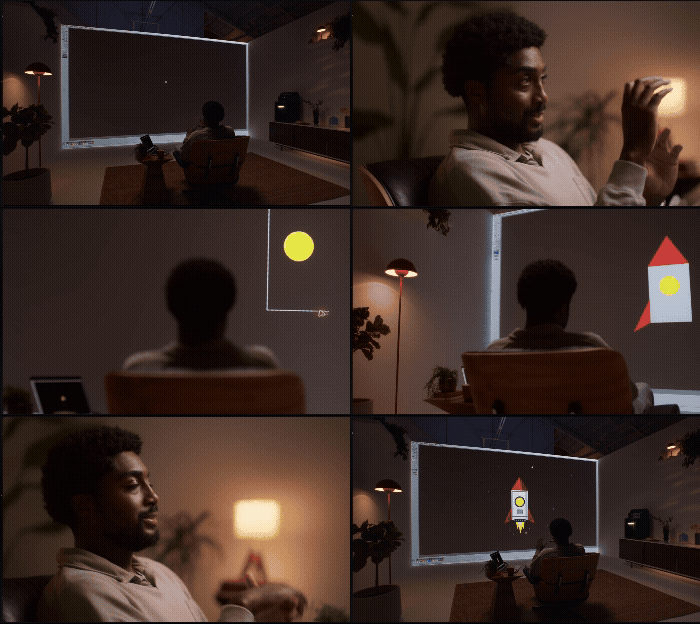
Astra can work through multiple steps and tools to turn an idea into a working result.
Credit: OpenAI.
The traditional AI workflow is familiar.
You provide an instruction.
You receive an output.
You review it.
You ask for changes.
You repeat.
The human remains responsible for connecting the steps.
Systems designed for computer use and multi-step work introduce another model:
Give the goal. Let the system work through the steps.
Instead of asking:
“How do I analyse this data and create a report?”
the interaction could become:
“Analyse this month’s performance and prepare a report highlighting what changed and what we should do next.”
The difference is subtle, but important.
AI is moving closer to participating in the workflow, rather than simply advising the person carrying it out.
From Ideas to Interactive Experiences
Game creation is a particularly good example of this shift.

Astra can bring games to life with graphics, gameplay and motion, allowing non-technical users to create and play custom games in minutes.
Credit: Pietro Schirano / OpenAI.
Astra isn’t limited to writing a game concept or generating snippets of code. OpenAI says it can create playable games with visual elements, gameplay and accurate motion.
In one example, game company Playco used Astra to turn a basic grey-box foundation into three themed game prototypes, with the company reporting 50% fewer manual fixes than with the previous model.
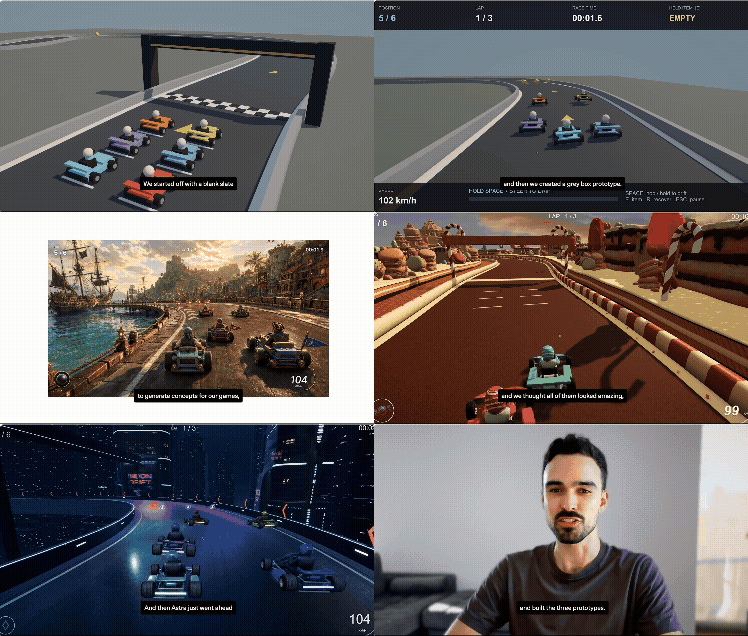
Playco used GPT-6 Astra to turn a grey-box game foundation into three themed game prototypes, with Astra helping build, test and refine the experiences. Credit: OpenAI / Playco.
That matters beyond gaming.
It demonstrates a broader change in what we can ask AI to produce.
Not just an idea.
Not just an asset.
But something people can actually interact with.
The same principle can apply to websites, web apps, prototypes and other digital experiences.
The Interface May No Longer Be the Starting Point
For decades, digital products have been built around actions.
Click.
Scroll.
Search.
Select.
Submit.
UX design has traditionally focused on making those actions clearer and easier.
But what happens when a user can simply state an outcome?
If an AI can navigate software and complete multiple steps, the interface is no longer only something the user operates.
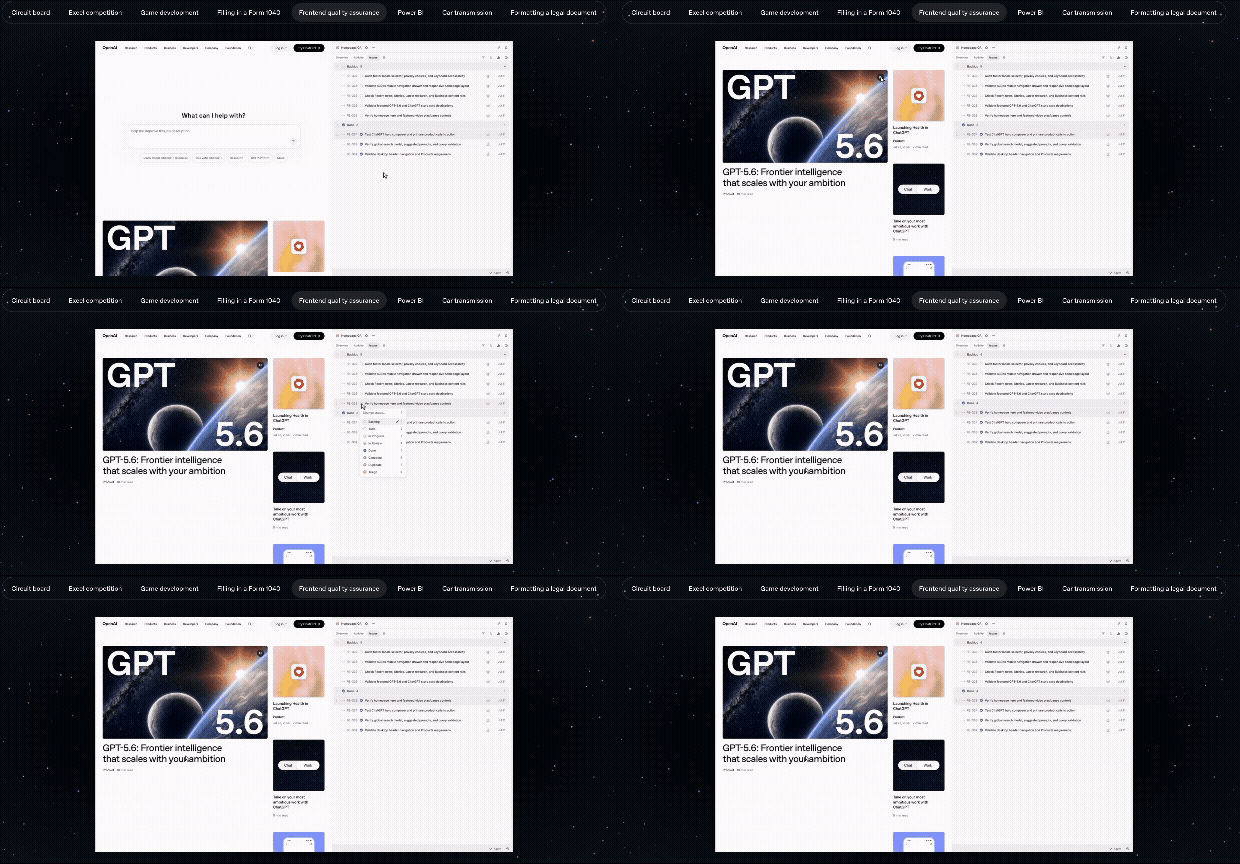
It demonstrates Astra working with a website/interface and checking whether its features actually work. That connects directly to your argument about AI no longer simply producing outputs, but interacting with software and interfaces.
It can become something the AI operates on the user’s behalf.
That creates new UX questions:
- What is the AI allowed to do?
- When should it ask for approval?
- How does the user know what happened?
- What happens when it makes a mistake?
- How easily can the user intervene?
The role of UX doesn’t become smaller.
It becomes more consequential.
The New UX Challenge: Trust
This may be one of the biggest challenges of agentic AI.
When a person clicks a button, they generally know what action they initiated.
When an AI completes ten steps in the background, the experience becomes less visible.
The user needs confidence without necessarily seeing everything that happened.
That creates a new balance:
Transparency without overload.
Automation without loss of control.
Intelligence without unpredictability.
The best AI experiences may therefore not be the ones that automate the most.
They may be the ones that make automation understandable.
What Changes for Creative Work?
Creative work has traditionally involved many handoffs.
Research.
Strategy.
Concept.
Copy.
Design.
Presentation.
Feedback.
Iteration.
AI already helps with many of these stages.
The next step is connecting them.
Imagine giving an AI a brand’s guidelines, previous campaigns, audience information, product details and campaign objectives then asking it to develop a campaign direction.
The interesting part isn’t that it can write copy.
We’ve had that for years.
The interesting part is whether it can maintain context across the process and keep the work aligned with the original objective.
That is where AI starts becoming less of a content generator and more of a workflow participant.
More Automation Doesn’t Mean Less Expertise
There is an easy assumption that if AI can execute more, human expertise becomes less important.
We think the opposite may be true.
When execution becomes easier, judgement becomes more valuable.
If everyone can ask AI for ten concepts, the advantage isn’t producing more concepts.
It is knowing which one is worth pursuing.
If everyone can create a prototype, website or game in minutes, the advantage isn’t simply being able to generate one.
It is knowing what should be built and why.
A strong brief becomes more valuable.
Strategy becomes more valuable.
Good UX principles become more valuable.
And creative direction becomes more important.
AI can increasingly handle the mechanics.
Humans still define the meaning.
From Designing Interfaces to Designing Interaction
This is perhaps the most interesting implication for designers.
We have spent years designing interfaces for people.
Now we’re beginning to design environments where:
People + AI + software + data
work together.
That means designers need to think beyond navigation and interaction.
They need to consider:
Intent – What is the user actually trying to achieve?
Agency – What should the AI be allowed to do?
Feedback – How does the system communicate what it is doing?
Control – When does the human take over?
Recovery – What happens when the AI gets something wrong?
Trust – Why should the user believe the result?
These are UX questions.
But they are also product and business questions.
The Real Change Is Where the Responsibility Moves
AI becoming more capable is not the most interesting part.
The bigger shift is where responsibility moves.
If AI handles more execution, people may spend less time telling software exactly what to do.
They may spend more time deciding:
what should happen in the first place.
That changes the value of creativity.
It changes the value of strategy.
It changes the role of UX.
And it changes what we expect from digital products.
The next generation of experiences may not simply help users complete tasks.
They may complete parts of those tasks with them.
So perhaps the question isn’t whether AI will change design.
It already is.
The question is:
Are we designing for a world where users operate products or a world where users increasingly delegate to them?
At 365CREA, we think that distinction is worth paying attention to.
Because when technology starts doing more of the work, the experience of deciding, directing and trusting it becomes the real design challenge.