
You probably won’t notice the biggest change Apple announced at WWDC 2026.
It isn’t a redesigned interface.
It isn’t a new app.
And it isn’t even Siri itself.
The real transformation is happening behind the screen, where AI is beginning to understand not just what users say, but what they are trying to achieve.
With the next generation of Siri powered by Apple Intelligence, Apple is introducing an assistant that can better understand personal context, maintain natural conversations, and work across applications to help users complete tasks more intuitively.
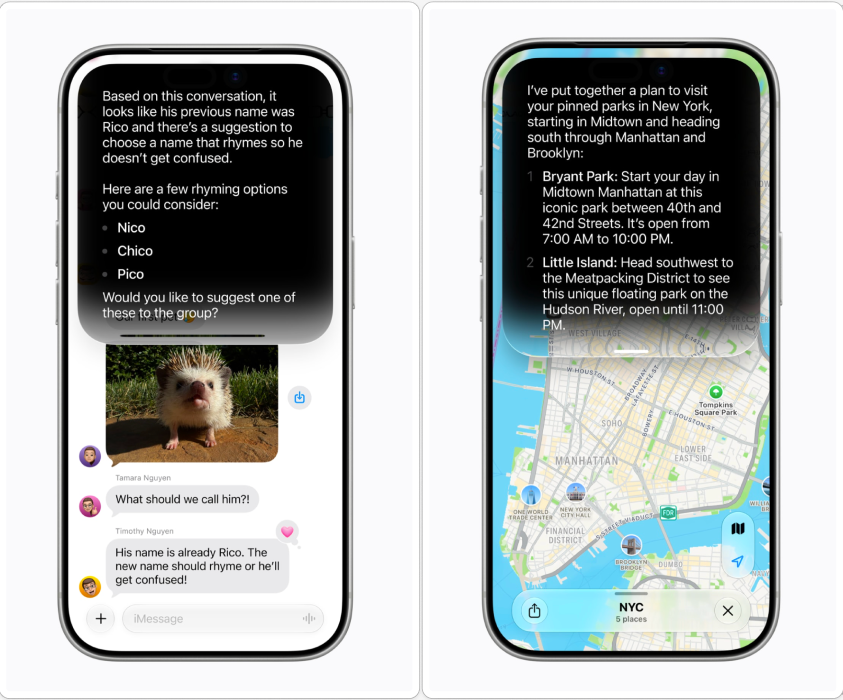
Siri analyses on-screen content and personal context across apps, tapping into real-time web knowledge to generate accurate, context-aware answers. (Source:apple.com)
While these new capabilities are impressive, they also reveal something much bigger: the way we design digital experiences is changing.
From completing tasks to understanding intentions
For years, digital interfaces have been built around actions. Users open an app, search for information, tap a button, and move on to the next step.
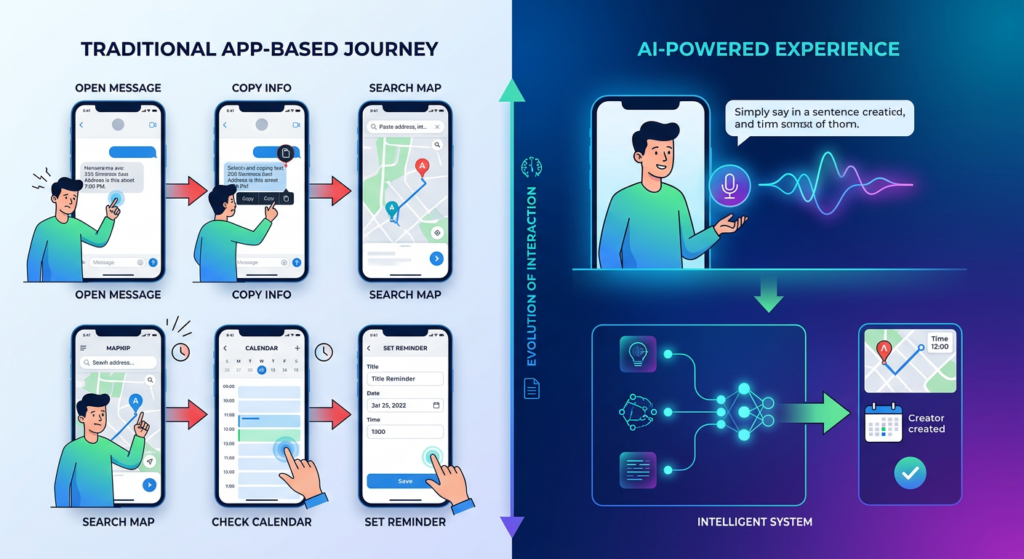
Shifting from actions to intentions: How Apple Intelligence simplifies complex, multi-app workflows into a single, cohesive user journey.
Apple’s new Siri introduces a different approach.
Instead of asking users to navigate through multiple apps, the assistant is designed to understand the intention behind a request and connect the information needed to complete it.
Imagine receiving a restaurant recommendation from a friend in Messages. Instead of reopening the conversation, copying the address, searching for it in Maps, and checking your Calendar for availability, you could simply ask Siri to organise your dinner plans. The assistant understands the context and helps bring the different pieces together.
The objective stays the same.
The journey becomes simpler.
For UX designers, this marks an important shift. The experience is no longer centred on where users click, but on what they want to accomplish.
Context is becoming the new interface
One of the most significant announcements made by Apple is Siri’s ability to understand personal context and work across apps while respecting Apple’s privacy-first approach.

Context becomes the interface: Siri leverages your personal context to instantly find photos, locate buried emails, or retrieve saved notes all while respecting Apple’s privacy-first approach. (Source: apple.com)
This changes the role of the interface itself.
Traditionally, navigation menus, search bars, and dashboards have helped users find information. As AI becomes more context-aware, those interactions may gradually become less central. Instead of searching, users describe what they need, and the system identifies the most relevant information.
Think about planning a business trip.
Your flight confirmation is in Mail, your meeting details are stored in Calendar, and your hotel address is saved in Maps. Rather than opening each app separately, AI can help connect everything into one seamless experience.
The interface doesn’t disappear.
It simply moves into the background.
The next challenge for UX designers
As AI assistants become more capable, a new UX challenge emerges: discoverability.
Buttons and menus naturally show users what they can do. AI, however, hides most of its capabilities behind conversation.
If users don’t know what they can ask, they may never discover the full potential of the experience.
This means designers will need to rethink how AI is introduced. Contextual suggestions, example prompts, and clear explanations will become just as important as intuitive navigation once was.
At the same time, trust will remain essential. Users need to understand what information AI can access, why it makes certain suggestions, and how they stay in control. A powerful experience is only valuable if it also feels transparent and predictable.
Looking beyond Apple
Apple’s latest announcements are not only about Siri.

The next generation of Apple Intelligence: AI centered around your needs—integrated into your apps, grounded in personal context, and private at every step across the entire ecosystem. (Source:apple.com)
They reflect a broader evolution that is already shaping digital products across the industry. Interfaces are becoming more intelligent, more contextual, and increasingly focused on helping users achieve goals rather than complete individual actions.
For UX designers and digital teams, this is a reminder that the future of user experience will not be defined by more screens or more features.
It will be defined by experiences that understand people better.
As AI continues to evolve, great UX will no longer be measured only by how easy a product is to use.
It will also be measured by how naturally it supports the people using it.
The interface isn’t disappearing. It’s becoming smarter.