
From Research to Launch: How AI Is Accelerating Modern Web Design
In many digital teams, it has quietly been observed that what once required several weeks of structured work is now being completed within a single working session.
Not because the discipline of web design has been simplified, but because the entire workflow from research to deployment is being reshaped by AI-assisted systems.
AI accelerates competitor analysis. Content structures are being generated in seconds. Interface variations are being tested before a single line of code is manually written. And yet, despite this acceleration, the quality of user experience still depends on one critical factor: how well strategy is applied.
AI has not removed the process it has compressed it.
A Shift in How Websites Are Being Built
Traditionally, website creation has been approached as a linear process:
research, wireframing, design, development, and iteration.
Today, this sequence is no longer strictly linear. It is being transformed into a continuous loop where AI tools assist at each stage.
Platforms such as Firecrawl, Google AI Studio, and Claude are increasingly being integrated into workflows to reduce friction between stages.
As a result, decisions that once depended on long research cycles are now being supported by structured, real-time insights.
1. Research That Is No Longer Manual
In conventional workflows, competitor research is often time-consuming and fragmented. Multiple websites are reviewed, notes are manually taken, and patterns are identified through interpretation.
Now, this process is being partially automated.
For example, when a business is preparing to launch a service-based platform, competitor websites can be analysed and structured data can be extracted within minutes. Layout patterns, messaging strategies, and conversion structures are no longer manually documented but are instead organized through AI-assisted scraping tools.
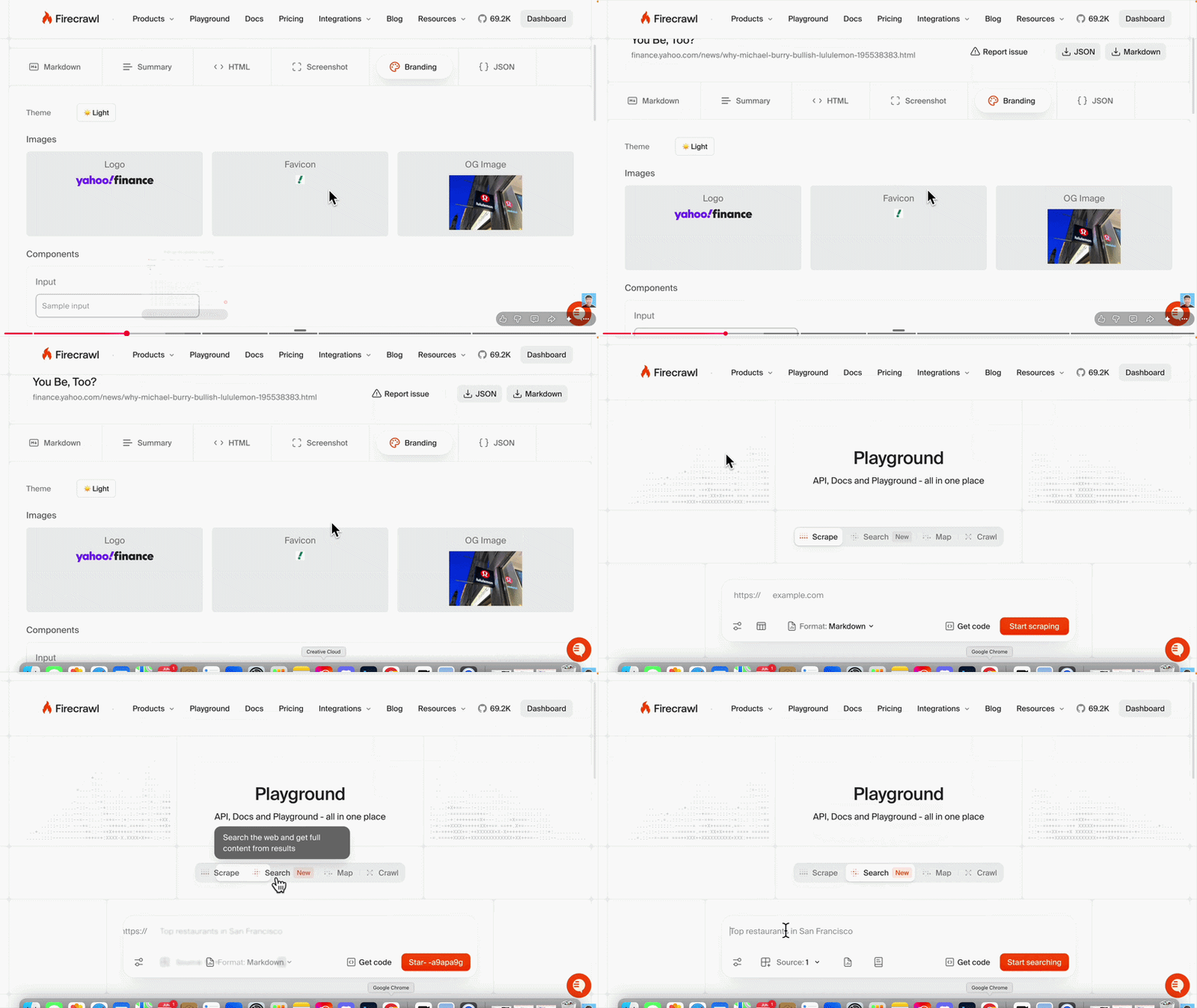
Navigating Firecrawl’s API playground to instantly scrape visual branding assets and structure automated search parameters.
Source: https://www.youtube.com/watch?v=5nA14JLCWfU
What previously required hours of manual synthesis is now being delivered as structured input ready for design decisions.
However, insight interpretation is still required. Data alone does not define strategy—it only supports it.
2. Design Briefs Are Being Generated, Not Just Written
Once research has been gathered, it must be translated into direction.
Traditionally, this step relies heavily on experience and documentation skills. However, AI systems are now being used to help structure this information into clearer design briefs.
User journeys, content hierarchy, and conversion goals can be outlined more efficiently, reducing ambiguity in early-stage planning.
For instance, in a booking platform scenario, AI-assisted workflows may help define:
- The most critical user entry points
- Required trust signals (reviews, guarantees, pricing clarity)
- Optimal placement of conversion elements
By structuring intent earlier, fewer decisions are left open during design and development phases.
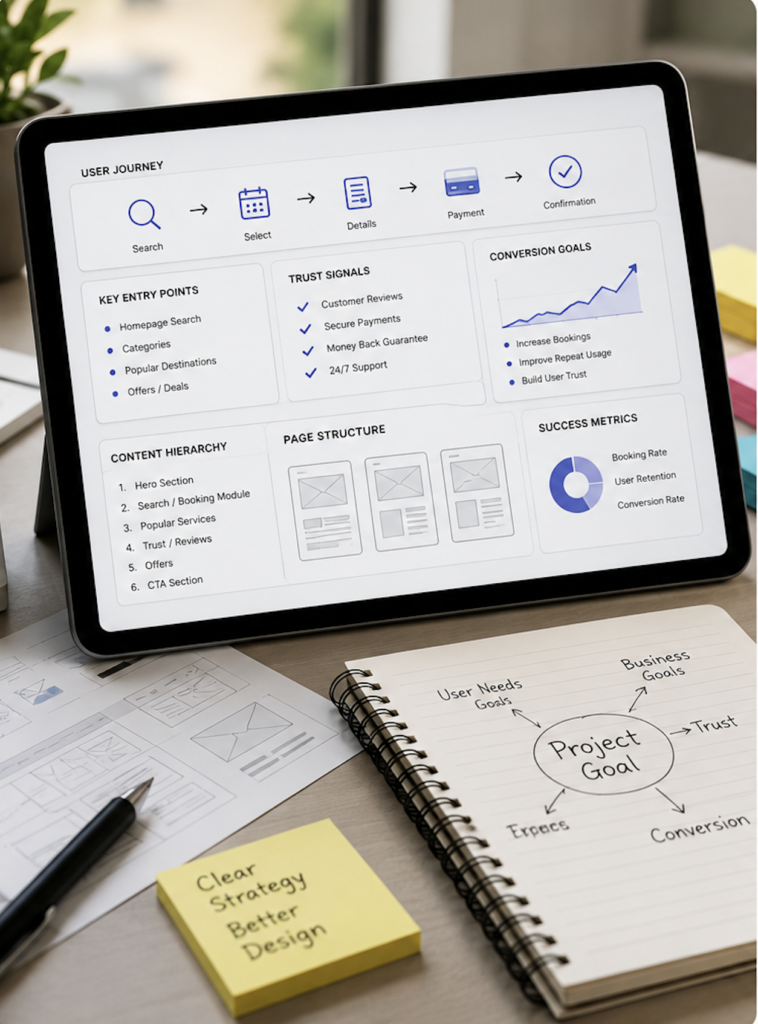
AI assisted workflows can transform research findings into structured design briefs that define user journeys, conversion goals, trust signals, and content hierarchy before designs begins.
This does not remove strategic thinking—it forces it to happen earlier in the process.
3. Interface Generation Has Become Iterative
One of the most visible changes in modern web design is the ability to generate interface concepts rapidly.
Using tools like Google AI Studio, initial layouts, sections, and even functional prototypes can be generated from structured prompts.
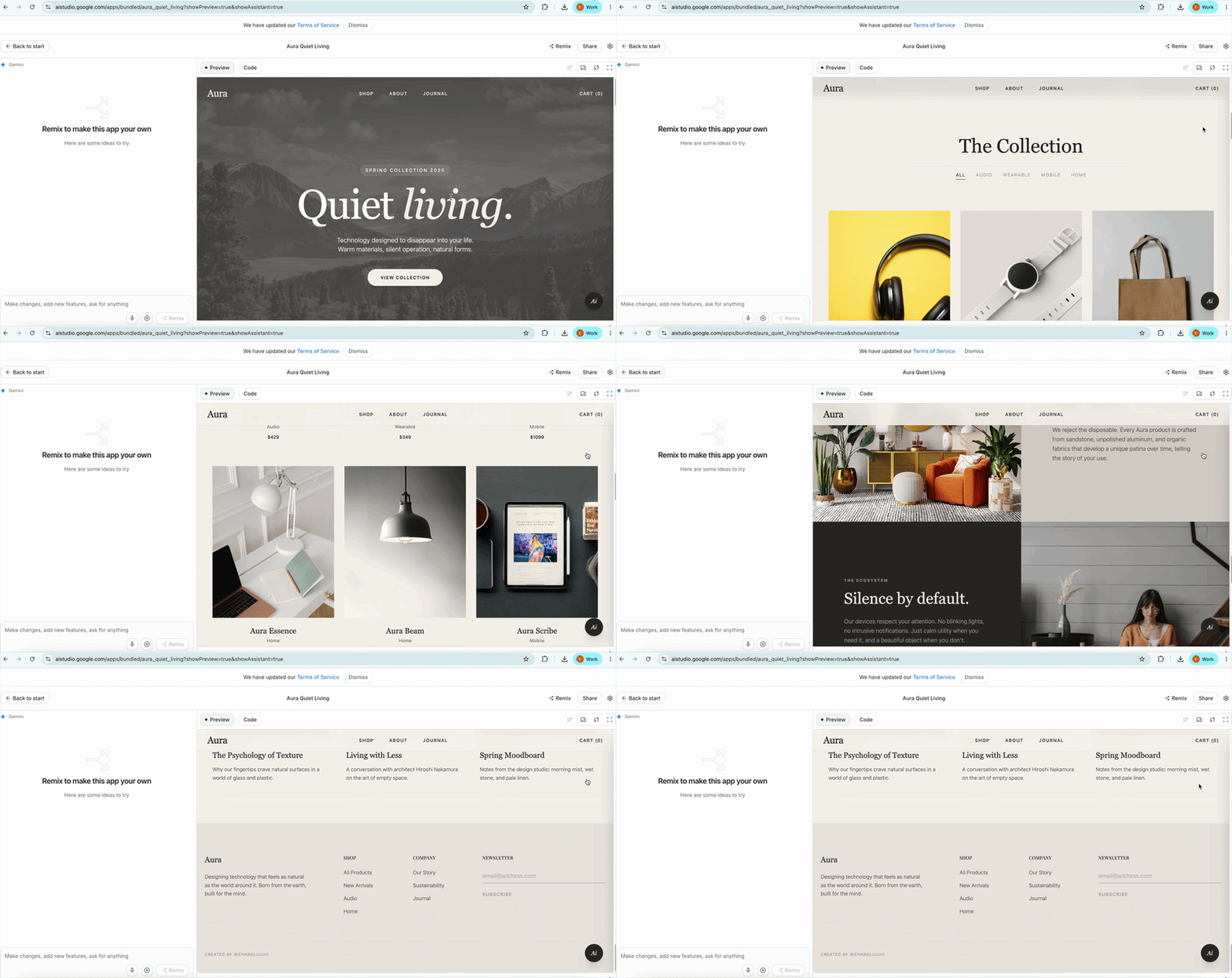
Iterating on a live homepage hero concept for a minimalist brand inside Google AI Studio.
Source: Google AI Studio
A homepage hero section, for example, can now be created in multiple variations within minutes:
- Different value propositions can be tested
- Alternative content hierarchies can be explored
- Visual structures can be adjusted instantly
Instead of designing one version and refining it slowly, multiple directions can be explored before finalisation.
The role of design is therefore being shifted from creation to selection and refinement.
4. Refinement Is Being Accelerated, Not Eliminated
Once a structure is generated, refinement becomes the most critical phase.
Here, tools such as Claude are often used to improve clarity, adjust content density, and enhance usability.
For example, if a landing page contains too much text in the hero section, it can be restructured into a clearer hierarchy within seconds. If navigation flow feels unclear, alternative structures can be proposed and tested rapidly.
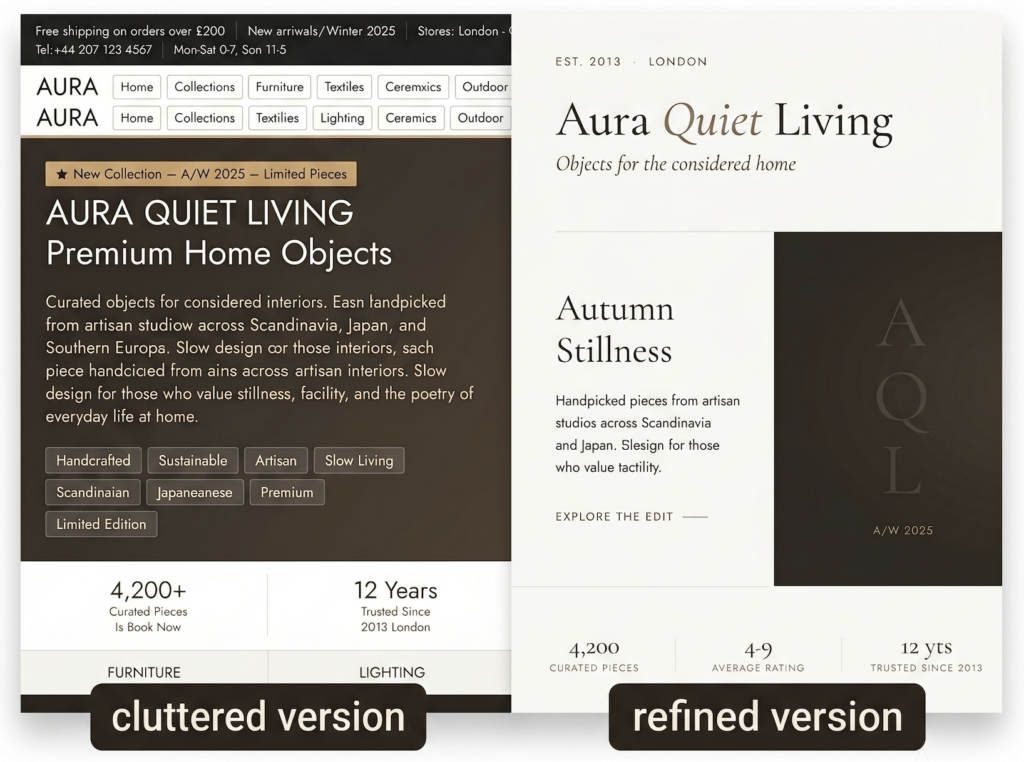
Restructuring dense hero elements using Claude. Left: Cluttered, repetitious text (intensified for demonstration). Right: Accelerated version: minimal text, massive breathing room.
A feedback loop is created where:
- Design issues are identified faster
- Adjustments are applied immediately
- Results are reviewed in real time
This cycle significantly reduces the delay between “problem identified” and “solution tested.”
However, usability judgment remains essential. AI can suggest changes, but it cannot validate experience quality in context of real users.
5. Visual Content Is Becoming More Dynamic
In addition to structure and layout, visual production is also being transformed.
Static assets are increasingly being replaced or enhanced with AI-generated visuals, animations, and dynamic media elements.
For example, a product landing page that previously relied on stock imagery can now be supported with custom-generated visuals aligned with brand identity. Motion elements can also be introduced to improve engagement and storytelling.
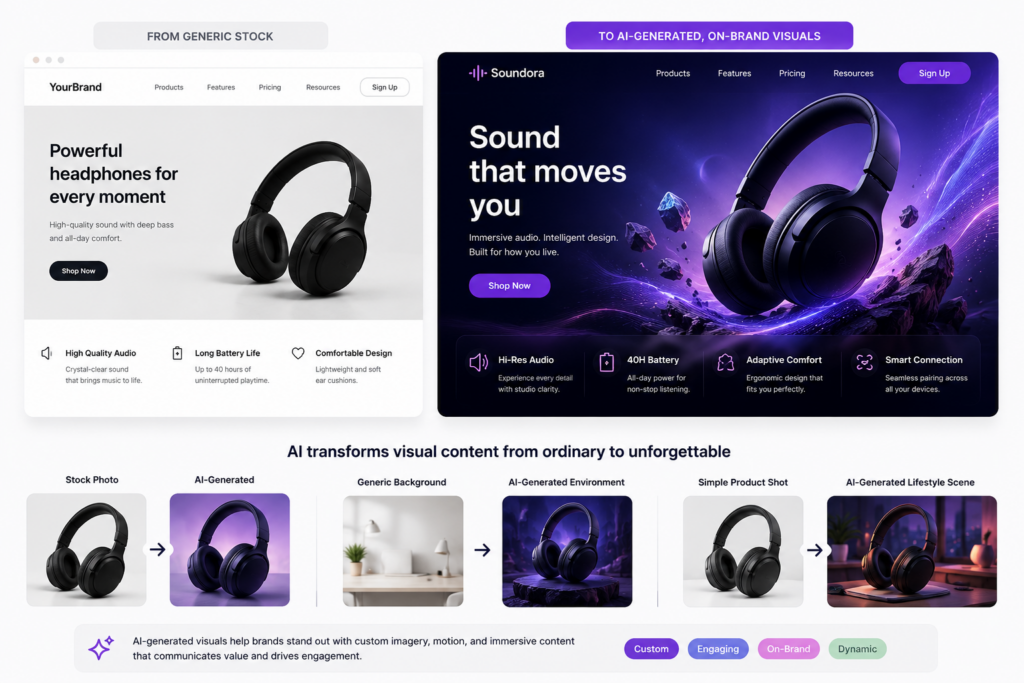
Visual production is evolving from static assets to custom-generated content, enabling more distinctive and engaging digital experiences while maintaining focus on user understanding.
However, visual enhancement is most effective when it supports clarity rather than distraction. The purpose remains the same: to guide attention and reinforce understanding.
Why This Is Useful
The primary benefit of this AI-accelerated workflow is not simply speed.
It is the efficiency of decision-making.
By reducing the time spent on repetitive tasks such as research compilation, layout generation, and initial content structuring, more focus is placed on:
- Understanding user behaviour
- Defining conversion logic
- Improving content clarity
- Strengthening information architecture
In practical terms, this means:
- Websites are being tested earlier
- Design decisions are being validated faster
- Iterations are becoming less costly
- Strategic thinking is being prioritised over manual execution
Faster Does Not Mean Better by Default
Despite these advantages, it has become clear that faster production does not automatically lead to better user experiences.
AI can generate interfaces, but it does not inherently understand:
- User motivation
- Emotional context
- Business constraints
- Trust-building requirements
These elements must still be defined through human judgment.
Without this layer of strategy, AI-generated websites risk becoming visually complete but functionally weak.
Conclusion: A Shift in Role, Not Replacement
The evolution currently taking place in web design is not defined by automation alone.
Instead, it is defined by a redistribution of effort.
Execution is being accelerated. Repetition is being reduced. Exploration is being expanded.
But direction, clarity, and purpose are still being defined by human decision-making.
The most effective digital experiences will not be those that were built the fastest. They will be those where AI was used to accelerate execution, while strategy was used to guide intention.
In this new landscape, web design is no longer just about building interfaces.
It is about orchestrating systems where research, design, and technology are aligned toward one outcome: better user experiences.