
Will Claude Replace UI Designers & Developers?
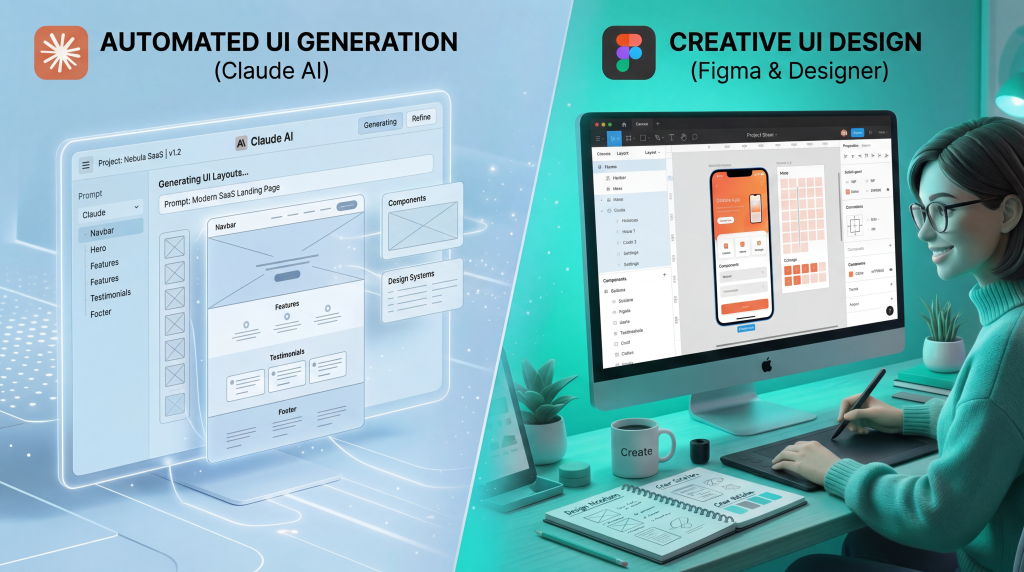
The Shift in Focus: Moving from manual UI generation to high-level creative direction as AI handles the execution layer.
Figma MCP Servers and the Future of Design Work
For years, UI design has been seen as a balance between creativity and execution — designers think, structure, refine, and then developers translate that vision into code.
But with the arrival of Figma MCP servers connected to Claude, that workflow is starting to change in a way that raises a difficult question:
If AI can read a design, understand it, and turn it into production-ready code… what happens to UI designers & Front end developers?
From Design Tool to Interpretable System
With the Model Context Protocol (MCP), tools like Figma are no longer isolated design environments.
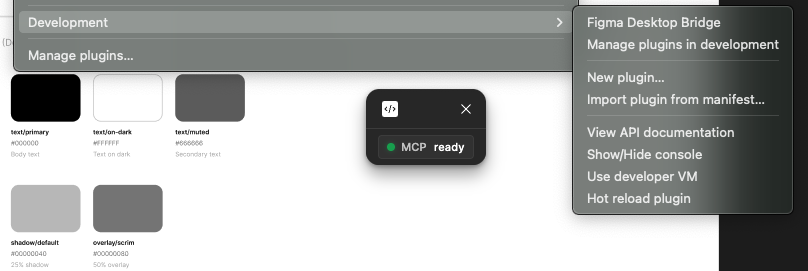
The MCP Bridge: A real-time connection allowing Claude to interface directly with Figma’s internal structure via the Model Context Protocol.
They become structured systems that AI can access directly.
When Claude is connected to a Figma MCP server, it can:
- Read full design structures (frames, components, styles)
- Understand layout logic instead of just visuals
- Convert UI elements into code (React, Flutter, etc.)
- Suggest improvements based on patterns and usability logic
Claude and Figma: Intelligent Interaction
By connecting Claude to a Figma MCP server, it becomes possible to:
- Extract elements from a frame and automatically generate React or Flutter components.
- Analyze an entire design system and produce actionable recommendations for development.
- Shorten the design-to-code workflow, while preserving visual fidelity.
In other words, Figma stops being just a canvas.
It becomes a machine-readable design database.
The Provocative Question: Is the Designer Still Needed?
Let’s be clear: Claude does not “design” in the human sense.
But it can already:
- Reconstruct interfaces from screenshots or Figma files
- Generate working UI components instantly
- Apply consistent design systems at scale
- Optimize layouts based on rules and patterns
So the question is no longer “Can AI design?”It is becoming “What part of design is still uniquely human?”
Human vs Claude: Two Ways of Building UI
1. The Human UI Designer
A UI designer typically:
- Interprets business goals and user needs
- Makes aesthetic and emotional decisions
- Iterates based on feedback, intuition, and experience
- Balances constraints (brand, usability, tech feasibility)
- Creates intentional design systems over time
Strengths:
- Context understanding
- Creativity and originality
- Emotional and cultural awareness
- Strategic thinking beyond the interface
Limitations:
- Time-consuming execution
- Repetitive production work
- Dependency on manual handoff to developers
2. Claude (via Figma MCP)
Claude operates differently:
- Reads structured design data instantly
- Converts UI into production-ready code
- Applies consistency across components automatically
- Generates variations or improvements in seconds
- Bridges design and development without translation loss
Strengths:
- Speed and scalability
- Precision and consistency
- Zero friction between design and code
- Ability to process entire design systems at once
Limitations:
- No true user empathy
- No lived product intuition
- No original creative intent
- Works within existing patterns, not outside them
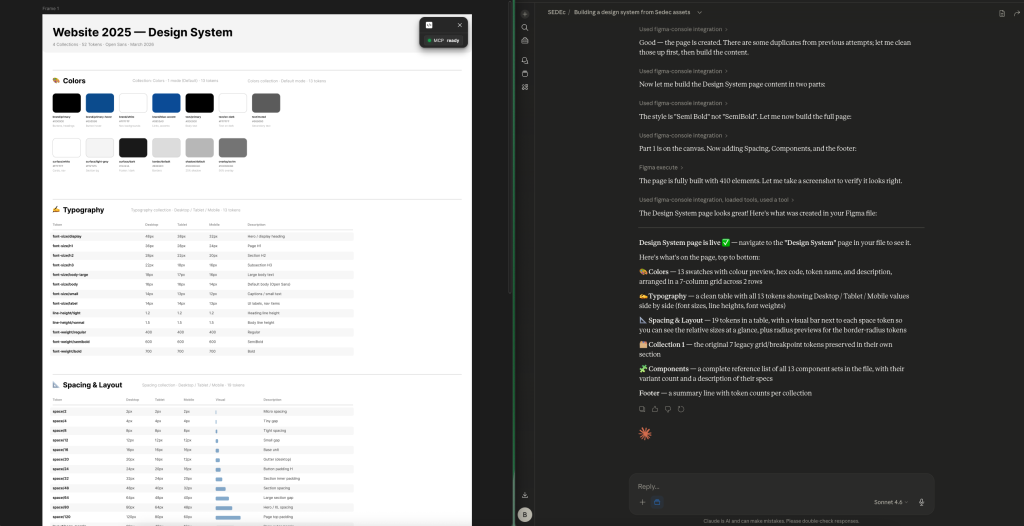
From Canvas to Code: Claude parsing a 2025 Design System, instantly extracting colors, typography, and spacing tokens into structured data.
What Actually Changes in the Workflow
The real shift is not “replacement vs no replacement.”
It is this:
Before:
Designer → Developer → Product
Now (with Claude + MCP):
Designer → Claude → Product (with developer supervision)
Claude becomes a translation layer that behaves like both assistant and executor.
But it still needs:
- Human direction
- Product decisions
- UX judgment
- Brand intention
So… Will Claude Replace UI Designers?
The honest answer is:
It will replace parts of UI design work — not UI designers themselves.
What is likely to disappear:
- Manual component conversion
- Repetitive layout rebuilding
- Design-to-code handoff bottlenecks
- Basic UI variations at scale
What becomes more important:
- UX thinking
- Product strategy
- System design
- Creative direction
- Decision-making under constraints
Final Thought
Figma MCP servers and Claude don’t remove designers from the process.
They change what “designing” actually means.
UI design is slowly shifting:
from making screens
to defining systems and intent that AI executes
So the real question is no longer whether AI will replace designers.
It is:
Will designers evolve fast enough to stay ahead of what AI can already execute?